
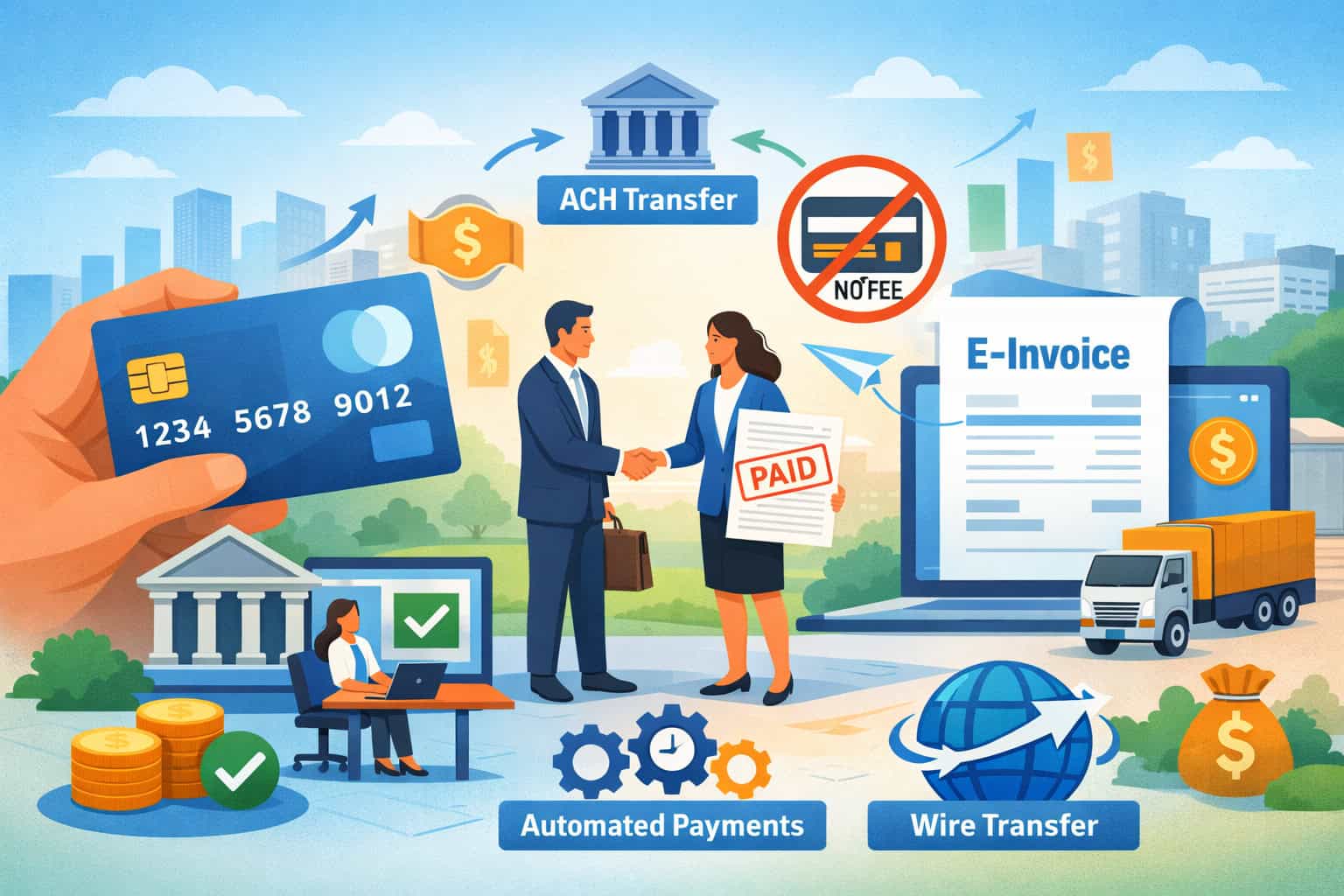
Controlling payment costs is not a back-office detail in B2B. It affects profit margins, pricing strategy, customer relationships, and cash flow.
When invoice values are high, even a small percentage in card fees can take a meaningful bite out of revenue, especially for distributors, wholesalers, service firms, manufacturers, field service companies, and recurring billing businesses.
That is why so many finance leaders are asking how to avoid credit card fees in B2B payments without making it harder for customers to pay. The answer is rarely to eliminate cards entirely. Instead, the goal is to build a smarter payment mix, encourage lower-cost options where appropriate, and reduce card costs when card acceptance is still necessary.
B2B payments work differently from consumer checkout. Larger invoice amounts, purchase orders, approval chains, remittance details, negotiated terms, and repeat relationships all shape how buyers want to pay. Those differences create real opportunities to save on payment processing costs B2B teams often overlook.
This guide explains where the fees come from, why B2B payment acceptance behaves differently than retail, and what practical steps can help lower merchant fees for business payments.
You will also learn when ACH, bank transfers, RTP, checks, virtual cards, portals, and invoice-based payment methods make sense, and how to cut business payment processing fees without slowing collections or hurting the customer experience.
Why credit card fees are a major issue in B2B payments
Credit card acceptance can look harmless on small transactions. On a modest charge, the fee may feel like a routine cost of doing business. In B2B, that logic breaks down quickly because invoice amounts are often much larger, margins may be tighter, and customers may pay on terms rather than at the point of sale.
A business that accepts a large number of invoice payments by card can easily lose a significant amount of revenue to percentage-based fees. On high-ticket invoices, the difference between a card payment and a lower-cost bank payment is not minor. It can mean the difference between a healthy gross margin and one that gets squeezed every month.
Another issue is that payment cost is not limited to the advertised discount rate. Businesses often absorb a stack of charges that includes interchange, assessment fees, processor markup, gateway costs, monthly platform fees, chargeback-related costs, and sometimes added expenses tied to manual reconciliation. Many teams focus on the visible percentage and miss the full acceptance cost.
B2B sellers also deal with customers who expect flexibility. Some buyers want cards for convenience, float, or rewards. Others prefer invoice-based payment methods or bank rails.
If a supplier accepts only cards, it may collect quickly but pay more than necessary. If it accepts only checks or manual transfers, it may reduce fees but create delays and extra work.
The real challenge is balancing cost control with speed and convenience. Businesses want to avoid credit card fees in B2B payments, but they also want to protect cash flow, reduce days sales outstanding, and make it easy for customers to complete payment correctly the first time.
Why a small fee becomes expensive on large invoices
B2B payments tend to involve larger average ticket sizes than consumer sales. A fee that seems manageable on a small transaction becomes much more painful on a five-figure invoice. For companies selling inventory, equipment, parts, logistics, or project-based services, that extra cost can stack up quickly across a month or quarter.
This becomes even more important when your gross profit on a sale is not especially high. If your margin on a transaction is already limited, a card fee may consume an outsized share of the profit. That is why reducing credit card processing fees B2B strategies matter so much in industries with large invoice amounts and competitive pricing.
Larger invoices also create more pressure to offer alternatives. Buyers may still prefer the convenience of a card, but sellers often have a financial reason to steer those transactions toward ACH, EFT, wire, or a payment portal that supports pay-by-bank options.
Those methods can lower acceptance cost while still preserving a professional, digital payment experience.
Why finance and AR teams care so much about payment mix
Accounts receivable teams do not just care about getting paid. They care about how payment arrives, how easily it can be matched to an invoice, how predictable settlement is, and how much it costs to collect. In B2B, the wrong payment method can create friction long after the money lands.
For example, a card payment may settle fast but come with a steep cost. A paper check may avoid percentage-based fees but create delays, lockbox handling, and more manual posting. A bank transfer may cost less but still create issues if remittance data is missing or the customer applies payment across several invoices without clear references.
That is why the best B2B payment processing cost reduction plans are not just about choosing the cheapest rail. They are about matching the right rail to the right transaction. A good payment mix reduces card fees on invoices where cost matters most while still supporting speed, reconciliation, and customer preference.
For many businesses, the ideal answer is not “cards versus non-cards.” It is a structured system where each invoice channel presents the most sensible options first.
How B2B credit card processing fees work

To lower interchange costs for B2B payments, it helps to understand how card fees are built. Most businesses see one blended rate on a statement or processor proposal, but that number usually combines several cost layers. Without understanding those layers, it is difficult to see where savings are actually possible.
The biggest component is usually interchange. That is the underlying fee structure tied to the type of card, transaction method, data quality, and other factors. Card network assessments and related brand fees sit on top of interchange. Then the processor or payment provider adds its own markup, plus any gateway or platform costs.
B2B card costs are influenced by more than just “credit versus debit.” Commercial cards, corporate cards, purchasing cards, card-not-present transactions, manually entered payments, and incomplete transaction data can all affect what the business pays.
On the positive side, some B2B transactions can qualify for better treatment when enhanced data is submitted correctly. That is where Level 2 and Level 3 processing concepts become important. Additional commercial card data can materially reduce the cost of certain B2B card transactions when the processor and payment flow support it.
Another common source of confusion is the pricing model your processor uses. Interchange-plus pricing, flat-rate pricing, tiered pricing, and custom enterprise structures all work differently.
A business trying to reduce card fees on invoices may think it is negotiating a better deal, but if the pricing model hides the true cost drivers, savings may be harder to measure.
The key point is simple: card fees are not random. They are influenced by transaction setup, payment acceptance workflow, data passed with the sale, and the commercial terms of your processor agreement. Once you know those drivers, you can begin making changes that save money without disrupting collections.
The main layers of card acceptance cost
Most B2B merchants pay three broad categories of card-related cost. Understanding them makes free conversations far more productive.
- Interchange: The base cost connected to the card transaction itself
- Network or brand fees: Charges tied to the card brands and network participation
- Processor markup and technology fees: The provider’s revenue plus software, gateway, reporting, or service charges
Interchange is usually the largest part, and it is where many B2B optimization opportunities live. Commercial card programs often reward richer transaction detail because it helps issuers and buyers manage procurement and reporting.
That is why enhanced business payment data can lower interchange costs for certain corporate and purchasing card transactions.
Network and processor charges matter too, but businesses often save the most by first fixing data submission, invoice workflows, and customer payment routing. Negotiation comes later, after you know what is happening inside the transaction stream.
Common fee types businesses pay when accepting cards
Many companies underestimate how many card-related fees they are actually paying. The transaction rate is only the beginning.
Common charges can include:
- Percentage-based processing fees
- Per-transaction authorization fees
- Gateway or platform fees
- Monthly account or statement fees
- Chargeback fees
- PCI-related fees
- Batch or settlement fees
- Address verification or security tool charges
- Cross-border or special card program fees where applicable
In B2B, the hidden cost is often operational. If your team is manually chasing remittance details, re-keying payments, correcting invoice mismatches, or handling avoidable disputes, those labor costs belong in the total acceptance picture too.
That is why businesses looking to cut business payment processing fees should review both direct fees and indirect process costs. A slightly more expensive bank-based workflow may still save money overall if it shortens collections time and reduces manual work.
Why B2B payment cost dynamics differ from retail

Retail payment acceptance is usually built around speed, convenience, and a quick yes-or-no checkout moment. B2B is different. A business payment often happens after an invoice is issued, after goods are delivered, or after internal approval steps are completed. That changes the economics.
In retail, a customer may make an emotional or impulsive decision and pay immediately. In B2B, the buyer often follows policy. They may need a purchase order, specific remittance information, line-item detail, approval routing, or a preferred payment method tied to accounts payable controls. That means the seller has more room to influence how payment is made.
B2B transactions also tend to have repeat relationships. Suppliers and customers may work together for months or years. Because there is an ongoing relationship, it is often possible to guide payment behavior more thoughtfully.
A seller can encourage ACH for larger invoices, reserve cards for deposits or urgent payments, and use portals or invoice links to present lower-cost options first.
Another major difference is that B2B buyers may actively prefer methods that support invoice matching and payment controls. A bank payment with clear invoice references can be easier for both sides to reconcile than a card payment with limited remittance.
In some cases, a virtual card may be buyer-preferred because it fits procurement controls, even if the seller would rather receive ACH.
These differences explain why alternatives to credit card payments for businesses are so important. The payment method is not just a checkout preference. It is part of the buyer’s finance workflow and the seller’s receivables strategy.
Why invoice-based selling changes the cost equation
Invoicing gives the seller a powerful advantage: the ability to shape the payment experience before the customer decides how to pay. Instead of a generic “pay now” moment, the invoice can present structured choices.
For example, an invoice can include a payment portal with ACH, card, and bank transfer options. It can explain that bank payment is preferred for larger balances. It can offer card acceptance for convenience while making pay-by-bank more prominent. It can also capture the exact invoice number or customer reference needed for reconciliation.
That makes B2B invoice workflows one of the best opportunities to save on payment processing costs B2B teams face. Rather than trying to force customers away from cards after the fact, you can design the invoice experience to support lower-cost methods from the start.
Why buyer expectations are different in B2B
Business buyers are usually not choosing payment methods only for convenience. They may care about control, timing, accounting treatment, internal approvals, or rewards tied to company cards.
Some want the float and reporting benefits of a card. Others prefer ACH because it aligns with AP automation. Some rely on virtual cards generated by their payable systems.
This is why one-size-fits-all payment acceptance usually performs poorly. It either pushes too hard toward cards or makes lower-cost methods too difficult to use. The better approach is to understand why each customer segment pays the way it does.
When encouraging non-card payment methods makes sense, the message should connect to the buyer’s workflow. Faster invoice matching, easier remittance handling, scheduled payments, and more predictable processing are all good reasons for a customer to choose a bank-based option.
B2B payment methods with no fees or lower fees
Businesses that want B2B payment methods with no fees should set realistic expectations. Very few payment methods are truly free in every situation. The more practical goal is to find methods with no percentage-based merchant fee or much lower total cost than card acceptance.
Bank-based methods are usually the first place to look. ACH, EFT, standard bank transfers, and in some cases RTP or other instant payment rails can be far more cost-effective than cards on larger invoices.
ACH remains a core electronic payment rail for businesses and governments, while newer instant payment options are expanding the ways businesses can move funds with speed and confirmation.
Checks are another option, though they are not always low-cost once handling, delays, lockbox services, exceptions, and manual posting are factored in. They may avoid card interchange, but they can still create real back-office costs.
Here is a practical comparison of common B2B payment methods:
| Payment Method | Typical Cost Profile for the Seller | Best Use Cases | Main Trade-Offs |
| ACH / EFT | Usually flat-fee or low-cost compared with cards | Recurring invoices, large invoices, account payments | Slower than instant rails, return risk, needs authorization and remittance discipline |
| Same-day or expedited bank payment | Higher than standard ACH, usually still below card cost on larger invoices | Time-sensitive invoice payments | Not always available to every payer |
| RTP / instant bank transfer | Often attractive for urgent payments where confirmation matters | Supplier payments, urgent settlements, request-for-payment workflows | Bank availability and setup can vary |
| Paper check | No card fee, but operational cost can be high | Traditional buyers, industries still dependent on checks | Delays, mail risk, manual handling |
| Wire transfer | Predictable fixed fee structure | High-value, urgent, or cross-border transactions | More expensive than ACH, less convenient for routine invoices |
| Virtual card | Often still carries card cost, but may be required by buyer AP programs | Enterprise buyers using AP automation | Seller pays card fees unless optimized with enhanced data |
| Standard credit card | High convenience and fast authorization | Deposits, urgent payments, smaller invoices | Highest percentage-based cost in many B2B cases |
For businesses comparing alternatives to credit card payments for businesses, ACH is often the starting point because it combines digital convenience with materially lower cost than percentage-based card fees. ACH is widely used for direct payments, while Same Day ACH can speed settlement in some use cases.
You can also learn more about ACH and eCheck payment options for invoicing and bank payments and a broader overview of how EFT payments work for electronic bank transfers.
ACH and bank transfers as a low-cost default
ACH is one of the strongest tools for businesses trying to avoid credit card fees in B2B payments. It is especially effective for recurring invoices, larger balances, and customers with established relationships.
Because ACH usually relies on flat or lower-cost pricing instead of a percentage of the invoice amount, the savings can be substantial as ticket size grows. ACH also works well when sellers want to offer a digital payment experience without absorbing card interchange on every payment.
The ACH network supports direct electronic payments broadly, and bank-based pay options are increasingly positioned as a lower-cost alternative for invoices and recurring billing.
The catch is that ACH needs good process design. Authorization, return handling, customer verification, and remittance capture all matter. If you offer ACH but make it difficult to use, customers may default back to cards.
RTP, instant bank payment, and request-for-payment workflows
Instant payment rails can help when speed matters but card fees feel unnecessary. RTP operates around the clock and is designed for immediate, confirmed money movement, while the FedNow Service also supports real-time payment capabilities and request-for-payment features through participating financial institutions.
For B2B collections, that can be powerful. If a buyer needs to release a payment quickly to secure shipment, close out a past-due invoice, or avoid service interruption, an instant bank payment may solve the timing problem without pushing the transaction onto an expensive card rail.
These methods are not universal yet, and adoption depends on what the payer’s and payee’s banks support. Still, for businesses exploring B2B payment methods with no fees or lower fees, instant bank options deserve attention, especially for urgent accounts receivable workflows.
How to avoid credit card fees in B2B payments without hurting cash flow
The biggest fear many businesses have is that if they push customers away from cards, they will slow down collections. That concern is valid. Cards are fast, familiar, and easy. But avoiding unnecessary card fees does not have to mean making payment harder.
The most effective approach is to guide payment behavior rather than force it. Present lower-cost options prominently on invoices.
Make ACH enrollment easy. Let customers save bank account details securely where appropriate. Use payment portals that capture remittance fields automatically. Reserve card acceptance for situations where speed or convenience justifies the cost.
This strategy works best when it is tied to invoice size and customer profile. For example, a business might accept cards on smaller invoices with no extra friction, while steering larger invoices toward ACH or other bank-based methods.
Another company may accept cards for deposits, but ask for bank payment on the final invoice. A recurring billing business may default new customers to ACH while still offering cards as a backup.
You can also improve cash flow by removing friction from non-card payments. If ACH requires paper forms, phone calls, or manual setup, customers will resist it. If the buyer can click a secure link, authorize payment, and receive a confirmation instantly, adoption improves.
For businesses handling invoice-based collections, a good payment portal matters. A modern portal can present multiple methods, automate reminders, reduce posting errors, and make pay-by-bank feel just as professional as a card payment page.
Solutions that combine cards, ACH, e-check, and invoicing in one interface can help businesses offer method choice while optimizing cost and workflow.
When encouraging non-card payment methods makes sense
Not every invoice should be pushed away from cards. Encouraging a non-card method makes the most sense when:
- The invoice amount is large enough that card fees materially affect margin
- The customer is a repeat buyer with an established relationship
- The payment is tied to an invoice rather than an impulse decision
- The buyer already uses ACH, EFT, or AP automation elsewhere
- The customer values remittance accuracy and structured reconciliation
- Your team can offer a digital, low-friction bank payment option
In those cases, alternatives to credit card payments for businesses often improve both economics and operations. You can preserve convenience while reducing card dependency.
How to guide customers toward lower-cost methods
Method steering should feel helpful, not pushy. The best version is built into the workflow.
Useful tactics include:
- Making “Pay by Bank” the first option on larger invoices
- Offering card and bank payment side by side, with clear explanation
- Using invoice copy that recommends ACH for larger balances
- Enabling secure bank account storage for repeat customers
- Offering scheduled ACH for customers who pay on terms
- Using reminders that link directly to the preferred payment method
A helpful supporting resource is this guide to building a long-term payments strategy, which explains why payment method design should match customer behavior and finance workflows.
How to reduce credit card processing fees B2B when cards cannot be avoided
Cards are not going away in B2B. Many buyers want them for convenience, float, rewards, or procurement controls. In some verticals, refusing cards is not realistic. The goal then shifts from avoidance to optimization.
One of the most important strategies is improving transaction data quality. Commercial card transactions can qualify for better economics when the payment flow supports Level 2 or Level 3-style data submission.
That may include tax amount, customer code, invoice number, purchase order number, shipping information, item details, and other fields depending on the card program and processor setup. Enhanced commercial card data can reduce processing costs for eligible B2B transactions when captured and transmitted correctly.
Invoice practices also matter. If your system collects incomplete information, submits inconsistent invoice references, or routes all card payments as generic keyed transactions, you may be paying more than necessary. Small operational changes can reduce card fees on invoices significantly over time.
Processor negotiations are another important lever, but they work best after the internal workflow is cleaned up. If your data is messy and your routing is poor, no pricing proposal will fully solve the problem. Once you have stronger acceptance practices, it becomes easier to compare providers and negotiate markups from a position of clarity.
Routing and platform capability matter too. If your gateway, virtual terminal, ERP integration, or invoice software cannot pass enhanced B2B data fields, you may be leaving money on the table.
For a deeper understanding, these guides on credit card processing levels for B2B transactions, Level 3 data, and the ultimate guide to Level II and III credit card data are useful background reading.
Use Level 2 and Level 3 data wherever your business qualifies
For businesses receiving commercial, corporate, or purchasing cards, enhanced data submission is often the most direct route to lower interchange costs for B2B payments. The exact requirements vary by card type, acceptance setup, and provider capabilities, but the principle is consistent: better data can lead to better economics on eligible transactions.
This matters most for B2B merchants with higher-ticket invoices, repeat accounts, and structured invoicing. If your platform can capture invoice number, tax amount, customer code, and line-item details, you may be able to reduce credit card processing fees B2B teams often accept as unavoidable.
However, this is not automatic. Your ERP, gateway, invoicing software, and merchant account configuration all need to support the required data flow. If even one part of that stack is missing the needed fields, transactions may not qualify.
Improve invoice and payment-entry practices
Many unnecessary card costs are caused by workflow habits, not rate tables. Common issues include:
- Keying transactions manually instead of using invoice links
- Allowing staff to submit incomplete invoice references
- Missing tax data on eligible commercial transactions
- Using generic item descriptions instead of structured line-item detail
- Running payments through the wrong channel or terminal type
- Accepting large invoices through a consumer-style checkout page
These mistakes do more than raise costs. They also create reconciliation problems and make dispute response harder. Standardizing invoice fields, staff procedures, and platform settings can lower interchange costs for B2B payments while also improving back-office efficiency.
Negotiate processor pricing after fixing internal leaks
Negotiation matters, but it should not be the first step. If your payment process is inefficient, you may save a little on markup while still overpaying on the base transaction structure.
Once you understand your payment mix and improve data quality, then it is time to review:
- Pricing model
- Processor markup
- Gateway fees
- Monthly account charges
- Batch or platform fees
- Chargeback-related costs
- Contract terms and add-on fees
At that stage, you can ask smarter questions and compare proposals more accurately. That is how businesses lower merchant fees for business payments in a durable way, rather than chasing teaser rates that do not solve the full problem.
Surcharging, convenience fees, and compliance considerations
Businesses looking for quick relief from card costs often ask about surcharging. It can reduce the seller’s burden by passing part of the card acceptance cost to the buyer, but it is not a simple switch to flip.
Surcharging rules depend on payment type, card-brand requirements, processor capabilities, disclosure standards, and jurisdiction-specific restrictions. Convenience fees also follow their own logic and are not interchangeable with surcharges.
Because these rules are sensitive and can change, any business considering them should work closely with qualified payments and legal professionals before implementation. High-level payment-strategy guidance often treats surcharging as just one tool among several, rather than the default answer.
From a customer-experience standpoint, surcharging can create friction in B2B just as it does elsewhere. Some buyers will accept it. Others will object, change payment methods, or escalate the issue internally. On larger invoices, that reaction can be strong.
That is why many businesses prefer a softer approach. Instead of adding a card fee, they encourage a lower-cost method like ACH for certain invoices. Others provide a discount for bank payment where allowed and appropriate. Some simply reserve card acceptance for smaller invoices or specific situations.
The neutral takeaway is this: surcharging may be workable for some businesses, but it is not always the best path to B2B payment processing cost reduction. In many cases, better payment-method design, ACH adoption, and Level 2/Level 3 optimization can deliver savings with less customer friction.
The difference between surcharging and convenience fees
These terms are often used loosely, but they are not the same thing. A surcharge is generally associated with adding a fee because the buyer uses a credit card. A convenience fee is tied to the use of a specific payment channel or alternative payment method under certain rules and conditions.
That distinction matters. Using the wrong structure, wording, or disclosure can create compliance problems. It can also create customer confusion, which increases payment friction and support volume.
For most B2B sellers, the safer mindset is not “How do we add a fee?” but “What payment design reduces cost while staying easy and transparent?”
When a softer steering strategy is better
Often, the best way to avoid credit card fees in B2B payments is simply to make lower-cost methods more attractive. A customer may never object if ACH is easy, well-presented, and tied to clean invoice matching.
That is especially true when the buyer is a repeat account. If the finance team can authorize bank payment once and reuse that method smoothly, they may prefer it over a card anyway. The seller gets lower cost, and the buyer gets a cleaner AP workflow.
In many cases, that approach preserves more goodwill than a visible fee line added to a card payment.
Common mistakes that increase payment acceptance costs
A surprising amount of payment waste comes from habits that feel normal inside the business. Teams get used to doing things a certain way, and over time those habits become expensive.
One common mistake is accepting every payment type through the same generic workflow. B2B transactions should not always be processed like consumer sales. Large invoices, repeat buyers, and commercial cards deserve more structured treatment.
Another problem is offering non-card methods in a weak or outdated way. If ACH requires paperwork, a call to accounting, or back-and-forth emails, customers will keep using cards. If a payment portal is confusing or does not capture remittance clearly, lower-cost methods will underperform.
Businesses also lose money when they ignore statement detail. Many companies know they “pay too much” but cannot explain which customers, card types, channels, or invoice sizes drive the cost. Without that visibility, the team ends up making guesses.
Manual key entry is another major issue. Keyed transactions are often more expensive and riskier than cleaner invoice-link or stored-credential workflows. Poor invoice practices, inconsistent descriptors, weak reconciliation controls, and outdated processor agreements can all raise total cost further.
A strong cost-reduction plan starts by identifying these mistakes honestly. Once they are visible, many are fixable without a major platform overhaul.
Mistake: Treating all customers the same
Not every payer should see the same payment options in the same order. A one-time small buyer may value convenience above all else. A long-term commercial account paying large monthly invoices may be an ideal ACH candidate.
When businesses ignore those differences, they miss easy savings opportunities. Segmentation is one of the simplest ways to reduce card fees on invoices without hurting customer experience.
Mistake: Focusing only on the rate and ignoring workflow
A lower quoted rate sounds good, but it does not fix broken invoice processes, weak remittance capture, or poor customer steering. Many companies switch processors and then discover their total cost barely changes because the underlying workflow stayed the same.
The businesses that save the most on payment processing costs B2B are usually the ones that optimize operations and pricing together.
Best practices for B2B payment processing cost reduction
The most successful cost-reduction strategies are structured, not reactive. They treat payments as an operational system that can be measured, improved, and aligned with the economics of the business.
A strong starting point is payment segmentation. Review invoice size, customer type, payment timing, and current method usage. Then decide where cards make sense, where bank payments should be encouraged, and where enhanced commercial card processing should be enabled.
Next, improve the invoicing experience. Add digital payment links. Make ACH or pay-by-bank easy to access. Capture invoice numbers and customer codes clearly. Use reminders that reduce friction rather than adding manual effort.
Then focus on the card side. Standardize commercial card data submission where possible. Make sure your gateway or invoice solution supports the necessary B2B fields. Review processor reporting for downgrades, interchange performance, and markup clarity.
Finally, revisit your provider relationship. Better reporting, cleaner integrations, and more capable invoice tools can matter as much as price. Payment optimization works best when technology, operations, and economics move together.
Build a payment mix by invoice type
A practical framework might look like this:
- Small invoices: Accept cards freely for convenience
- Mid-sized invoices: Offer ACH and card side by side
- Large invoices: Make bank payment the recommended option
- Recurring invoices: Default to ACH where appropriate
- Commercial card accounts: Optimize for enhanced data instead of discouraging card use blindly
- Urgent or time-sensitive payments: Offer instant bank payment or wire where speed matters
This kind of structure helps cut business payment processing fees while keeping the customer journey clear and consistent.
Make non-card payments easy to adopt
Lower-cost methods win when they are easy, visible, and trustworthy. That means:
- Clear payment instructions
- Secure payment links
- Stored bank payment setup for repeat accounts
- Transparent confirmation messages
- Automated reminders
- Accurate remittance capture
- Fast internal posting and reconciliation
Many businesses fail here because they treat ACH like a backup option instead of a primary B2B payment method.
How to choose the right payment mix for your business model
There is no single “best” B2B payment mix. The right answer depends on your average invoice size, margin structure, customer relationships, industry norms, cash-flow needs, and internal systems.
A distributor with large repeat invoices may benefit heavily from ACH-first collections. A project-based service firm might accept cards for deposits and bank transfers for milestone invoices.
A software company may keep cards for self-serve convenience but encourage ACH for larger annual contracts. A supplier working with enterprise buyers may have to accept virtual cards while optimizing data to reduce cost.
The question is not whether cards are good or bad. The real question is where cards create enough value to justify their cost, and where a different rail would work better.
When choosing your mix, ask:
- What is our average invoice size by customer type?
- Which customers care most about speed, controls, or remittance detail?
- Where do card fees hurt margin the most?
- Which non-card methods can we make easy and professional?
- Do we receive many corporate or purchasing cards that could qualify for better data treatment?
- How much manual work does each payment method create after collection?
The answers will point you toward a more balanced system. In most cases, the best mix includes both cards and bank-based methods. The goal is to use each intentionally.
Business models that often benefit from ACH-first strategies
ACH-first approaches often work well for:
- Wholesalers and distributors
- Manufacturers
- Business service providers with recurring invoices
- Membership or subscription-based B2B companies
- Property and facility service vendors
- Education, tuition, or contract billing operations
- High-ticket project and milestone billing
These businesses usually have predictable invoicing and established customer relationships, which makes bank payment adoption more realistic.
Business models that may still need strong card support
Card acceptance remains important for:
- Remote sales teams taking urgent payments
- Mixed B2B/B2C businesses
- Companies with many first-time buyers
- Businesses taking deposits before service or fulfillment
- Sellers working with AP departments that prefer virtual cards
- SaaS and online service businesses where convenience drives conversion
In these cases, the focus should be on reduce credit card processing fees B2B optimization rather than card elimination.
Frequently Asked Questions
Can a business completely avoid credit card fees in B2B payments?
What is usually the lowest-cost digital payment method for B2B invoices?
Are checks cheaper than credit card payments?
Do Level 2 and Level 3 data help reduce B2B card processing costs?
Should businesses stop accepting credit cards on invoices altogether?
When does it make sense to encourage ACH instead of card payments?
Are virtual cards good or bad for B2B sellers?
How can accounts receivable teams lower payment costs without making it harder for customers?
Conclusion
If you want to avoid credit card fees in B2B payments, the answer is not to make payment harder. It is to make payment smarter.
That starts with understanding why B2B payment costs behave differently, where card fees come from, and which transactions actually need card acceptance.
From there, businesses can reduce credit card processing fees B2B by steering larger invoices toward ACH and bank transfers, improving invoice workflows, using portals that support pay-by-bank, and optimizing commercial card transactions with better data.
The strongest results usually come from a balanced payment mix. Cards still have a role. So do ACH, EFT, RTP, checks, wires, and invoice-based options. The businesses that win are the ones that match the right method to the right transaction instead of relying on one rail for everything.
When you combine lower-cost payment methods, better invoice practices, stronger data quality, and more informed processor decisions, you do more than cut fees. You improve cash flow, reduce manual work, and create a payment experience that works better for both your team and your customers.