
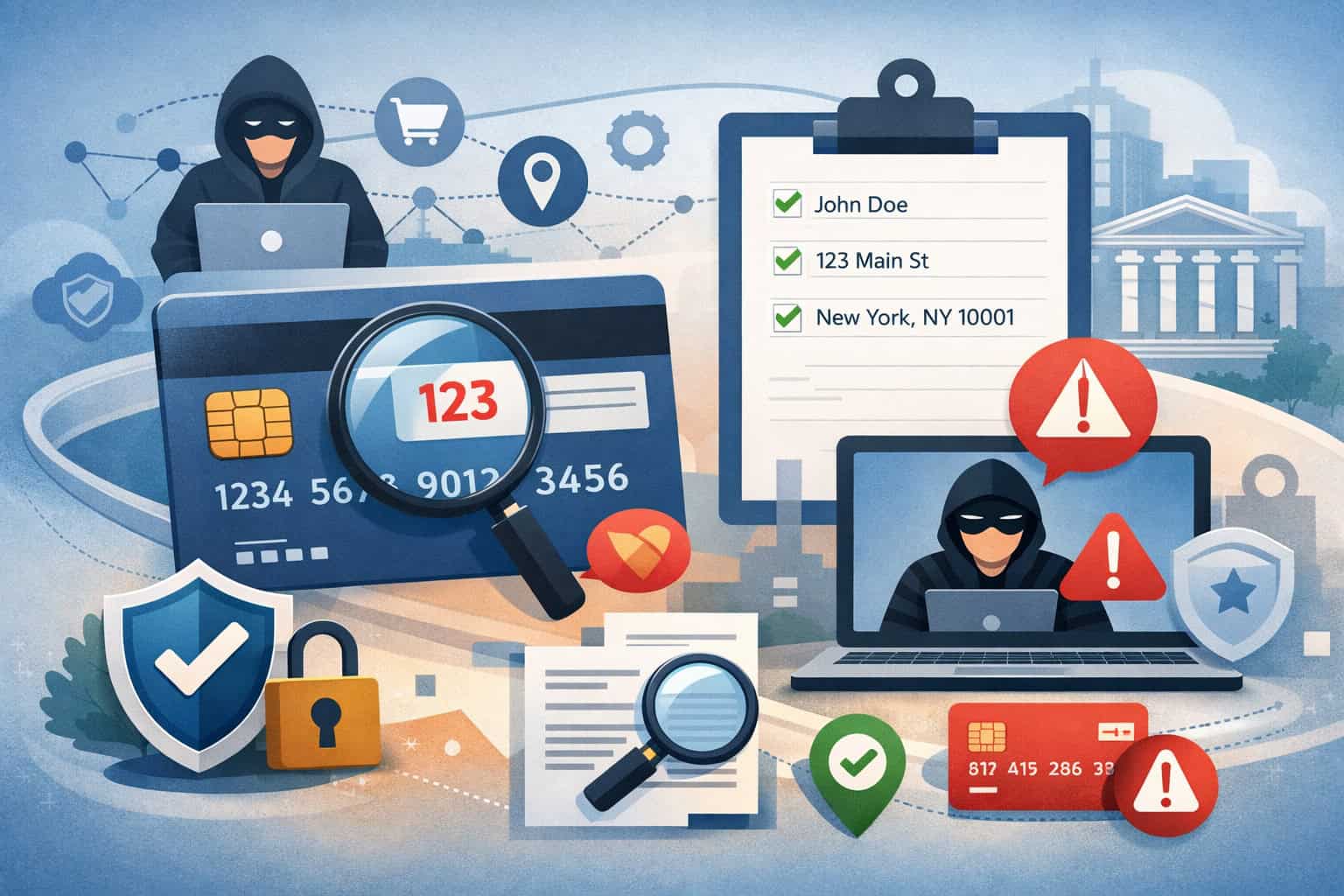
Every business that accepts online, phone, or manually keyed card payments faces the same problem: a card number can be stolen in seconds, but the cost of fraud can linger for months.
A single bad transaction can lead to lost merchandise, chargeback fees, extra operational work, and a higher-risk merchant profile. That is why CVV and AVS checks matter so much in day-to-day payment acceptance.
Used well, these tools help merchants verify whether a buyer likely has the card and knows the billing details tied to it. They are not magic shields, and they do not stop every fraudulent order. But they are still two of the most practical, accessible, and effective first-line controls for card-not-present payments.
This article explains exactly what CVV and AVS checks are, how the AVS verification process works, how CVV verification for payments works, what common match and mismatch results mean, and how merchants can use both in a layered fraud prevention strategy.
You will also learn where these checks fall short, when manual review makes sense, and how to combine them with other payment fraud screening tools for better protection and fewer unnecessary declines.
What CVV and AVS Checks Are and Why They Matter
CVV and AVS checks are two separate verification tools used during card-not-present transactions. They often appear together in online checkout flows, virtual terminals, payment gateways, and recurring billing systems because they address different parts of the same fraud problem.
A CVV check focuses on the security code printed on the card. It helps confirm that the customer likely has access to the physical card at the time of purchase. An AVS check focuses on the billing address, usually the street number and ZIP code, and compares what the customer enters against what the card issuer has on file.
These tools matter because most online fraud does not happen with a stolen physical card handed over at a checkout counter. It happens when someone has card data but not necessarily the rest of the cardholder’s information.
Fraudsters may buy stolen card numbers, test them with small purchases, and then place larger orders once they find working accounts. CVV and AVS checks make that harder.
They also matter because they give merchants something just as valuable as a yes-or-no answer: risk signals. A full match may support automatic approval. A partial match may justify further review.
A complete mismatch may suggest declining the transaction or asking for another payment method. In other words, CVV and AVS fraud prevention is not just about blocking bad orders. It is about making better decisions with better data.
Why these checks are especially important for card-not-present payments
In a card-present environment, the card can be dipped, tapped, or inserted, and the payment terminal may capture additional security data. In a card-not-present environment, the merchant loses that benefit. There is no physical card inspection, no signature comparison, and no in-person interaction with the buyer.
That makes fraud prevention for card-not-present transactions much more dependent on data points collected during checkout. CVV and AVS checks fill part of that gap.
The customer may know the card number and expiration date, but not the card verification value or correct billing address. That difference can help catch unauthorized use before the payment is fully accepted.
These checks are also useful because they work in real time. Instead of discovering suspicious behavior only after a dispute appears, merchants can respond during authorization.
That can mean rejecting a risky order, flagging it for manual review, or applying extra controls such as 3-D Secure, velocity checks, or identity verification.
Merchants that sell online, accept MOTO orders, handle subscriptions, or use a virtual terminal should treat AVS and CVV checks as baseline controls. They are not advanced enterprise tools reserved for large companies. They are practical safeguards for everyday payment acceptance.
How CVV Verification for Payments Works

CVV verification for payments is designed to check whether the customer can provide the short code associated with the card. On most cards, that code is a three-digit value on the back.
On some cards, it is four digits on the front. The code is not supposed to be stored after authorization, which is why it is a useful signal during checkout.
During the payment process, the customer enters the code along with the card number, expiration date, billing address, and other checkout details. The payment gateway passes that CVV data to the processor and on to the card issuer or network for validation.
The issuer then returns a response code indicating whether the submitted code matched its records, did not match, was not processed, or could not be verified.
This is where many merchants misunderstand the card verification value check. The code does not reveal whether the customer is definitely legitimate. It simply tells you whether the code entered aligns with what the issuer expects.
A fraudster with full stolen card details may still pass the check. But in many fraud attempts, the CVV is missing or incorrect, and that makes it a valuable control.
CVV checks are most useful when merchants act on the results consistently. A business that collects the code but ignores a mismatch gives away much of the benefit. The real value comes when the gateway, fraud rules, or review team uses the outcome to decide whether the transaction should be approved, reviewed, or declined.
What the card verification value check does and does not prove
A successful CVV result suggests that the buyer had access to the correct code at checkout. That is meaningful, but it is not the same as identity verification. It does not confirm that the buyer is the authorized cardholder.
It does not prove that the order is low risk. It does not tell you whether the shipping address, email, IP location, or buying behavior is normal.
That is why CVV verification for payments should never be treated as a standalone green light. A fraudster who purchased full card data, including the CVV, may still pass. A legitimate customer, on the other hand, may accidentally mistype the code, use an outdated saved card, or struggle with a damaged card where the printed code is hard to read.
Merchants should also remember that some issuers or transaction environments may return unavailable or unsupported results. That does not automatically mean the transaction is fraudulent. It means the merchant needs another layer of decision-making. This is one reason CVV and AVS checks work better together than alone.
Common CVV response outcomes merchants may see
Although code definitions vary somewhat by processor or gateway, merchants typically see a small set of practical outcomes. These include:
- Match: The CVV entered matches the issuer record.
- No match: The code does not match.
- Not processed: The issuer did not process the CVV check.
- Should be present / missing: The code was expected but not provided.
- Unavailable / unsupported: The issuer or card type could not return a valid response.
A no-match result is one of the clearest warning signs in online payments, especially for first-time customers, high-ticket orders, digital goods, or expedited shipping. But even here, context matters.
A customer may simply enter the wrong digits once and then correct them on a second attempt. That may be normal. Multiple failed attempts across different cards or accounts is much more concerning.
For merchants, the best practice is to decide in advance what each outcome should trigger. Do you auto-decline on no match? Do you route unsupported results to manual review for orders over a certain amount? Do you allow a retry only once? Clear rules reduce inconsistency and help customer support respond confidently when payments are declined.
How the AVS Verification Process Works

The AVS verification process checks whether the billing address entered at checkout matches the address information the card issuer has on file. In most cases, AVS looks primarily at the numeric portion of the street address and the ZIP code, not the full written address line.
When a customer places an order, the gateway sends the billing address information along with the authorization request. The issuer compares that data to its records and returns an AVS result. Depending on the response, the gateway can approve, flag, or decline the payment based on the merchant’s settings.
This is where the address verification service becomes especially useful. Many fraud attempts use stolen card numbers without the correct billing details. Even when a fraudster has enough information to pass the CVV check, the AVS result may still show a mismatch or partial match. That gives merchants another signal before shipping goods or delivering services.
At the same time, AVS is not perfect. A customer may recently have moved, may type the address differently, or may use a business or apartment format that creates a partial mismatch.
AVS can also be less reliable with some international cards, issuer limitations, and unusual address formats. That is why merchants should understand the difference between full match, partial match, and mismatch rather than treating AVS as a blunt pass-fail tool.
What information AVS compares during authorization
The address verification service does not usually analyze the entire billing address the way a shipping software tool might. Instead, it focuses on matchable billing elements, especially the street number and ZIP or postal code. The issuer then returns a code indicating what matched and what did not.
A full AVS match means the submitted billing data aligns with the issuer’s records in the way the network expects. A partial match may mean the street number matched but the ZIP did not, or the ZIP matched but the street number did not. A mismatch means neither matched, or the issuer was unable to verify the details.
This matters because different mismatch patterns carry different levels of risk. For example, a ZIP-only match on a digital product order may deserve review. A street match with a minor ZIP typo from a returning customer may be much less concerning. The AVS verification process gives merchants more nuance than a simple approved or declined message.
Why AVS partial matches deserve more attention than many merchants give them
Many merchants either ignore partial matches or decline too many of them. Both approaches can be costly. A partial match often sits in the middle ground where the best decision depends on other data points.
Consider an order where the street number matches but the ZIP code does not. That could be a simple typo, an old billing ZIP after a recent move, or a fraud attempt using a guessed address.
On its own, the AVS code cannot tell you which one it is. But when combined with customer history, device data, IP geolocation, order value, shipping speed, and CVV results, the picture becomes much clearer.
This is why mature fraud prevention programs do not rely on AVS and CVV in isolation. They use them to help sort orders into buckets: approve, review, challenge, or decline. For many merchants, the most expensive mistake is not approving a few borderline fraud attempts. It is losing large numbers of legitimate sales because the rules are too rigid.
CVV vs AVS: The Difference and Why You Need Both
The difference between CVV and AVS is simple but important. CVV checks whether the security code entered by the customer matches the code associated with the card.
AVS checks whether the billing address details entered by the customer match the billing address on file with the issuer. One validates card possession signals. The other validates address knowledge signals.
That distinction matters because fraud rarely fails in just one place. A stolen card profile may include the card number and expiration date but not the CVV. In another case, it may include the CVV but not the correct billing address.
In still another, the fraudster may have both but trigger concern through shipping behavior, order velocity, or device anomalies. That is why CVV and AVS fraud prevention is strongest when both tools are enabled and actively used.
The table below offers a practical comparison.
| Feature | CVV Check | AVS Check |
| What it verifies | Security code on the card | Billing address details on file |
| Primary goal | Confirm likely card possession | Confirm billing address knowledge |
| Most useful for | Catching stolen card data without full card details | Catching stolen card use with incomplete billing information |
| Typical result types | Match, no match, unavailable, not processed | Full match, partial match, mismatch, unavailable |
| Common merchant mistake | Collecting CVV but ignoring mismatch results | Treating every partial match as fraud |
| Best use | With rules for retries, risk scoring, and review thresholds | With customer history, shipping review, and layered screening |
The key takeaway is not that one is better than the other. It is that they solve different parts of the fraud problem. Used together, they create stronger verification than either tool can provide alone.
Why one match without the other should not always be treated the same way
A common merchant mistake is assuming that any single match is good enough. For example, if CVV passes but AVS fails, some merchants approve the order without further review. Others do the same when AVS passes but CVV fails. Both shortcuts can create unnecessary exposure.
An AVS and CVV mismatch combination is one of the clearest warning signs. But mixed outcomes need careful handling too. A CVV match with an AVS mismatch may mean a fraudster has full card details but not the correct billing address.
An AVS match with a CVV mismatch may suggest a customer typo, a card reissue, or a suspicious attempt where the billing information was known but the code was not.
The smarter approach is to define risk tiers. For example:
- Low risk: CVV match + full AVS match + familiar customer data.
- Medium risk: CVV match + partial AVS match, or AVS match + low-value order.
- High risk: CVV no match + AVS mismatch, especially with unusual shipping or high-value goods.
This layered interpretation is how merchants turn raw response codes into real decisions.
What Payment Processors and Gateways Do With CVV and AVS Results
Payment processors and gateways do more than simply pass back a result code. They often allow merchants to use CVV and AVS checks as part of configurable fraud filters, order screening logic, and routing decisions.
In practice, once the processor receives the issuer response, the gateway may do one or more of the following:
- Approve the transaction automatically
- Decline it based on preset rules
- Hold it for manual review
- Trigger additional authentication steps
- Store the result code for later analysis or dispute evidence
This flexibility is where many merchants gain or lose value. If AVS and CVV checks are turned on but no thoughtful action rules are built around them, the business gets limited benefit. On the other hand, if the rules are too strict, the checkout experience suffers, and legitimate customers may be declined unnecessarily.
A strong setup uses the gateway to translate response codes into business actions. For example, a full match may flow through with little friction. A partial AVS result on a high-value physical-goods order may trigger review.
A no-CVV-match result may be declined outright for first-time customers but manually reviewed for existing subscription clients. The gateway becomes the control center that turns verification signals into operational decisions.
How fraud filters, rules, and review queues should work together
Merchants often think fraud controls must be either fully automated or fully manual. The best programs use both. Automation handles obvious low-risk and high-risk cases. Human review handles the middle.
A useful model looks like this:
- Auto-approve: Full AVS match, CVV match, normal order size, established customer, no unusual device or shipping signals.
- Manual review: Partial AVS result, higher-than-normal order amount, first purchase, overnight shipping, or digital goods with mixed verification results.
- Auto-decline: CVV mismatch, full AVS mismatch, repeated failed attempts, suspicious velocity, freight-forwarding patterns, or known risky email and IP signals.
This kind of structure helps merchants reduce fraud without treating every order like a threat. It also creates more consistency for staff. Customer service teams know why an order was held. Risk teams know what documentation to review. Operations teams know when to delay fulfillment.
For merchants evaluating their stack, articles on payment gateway security features and fraud prevention and chargeback support can be useful starting points when thinking about how gateway controls and support processes fit together.
Common CVV and AVS Response Outcomes and What Merchants Should Do
A response code is only useful if the merchant knows how to respond. Too many businesses enable CVV and AVS checks but never build a playbook for match, partial match, mismatch, or unavailable results. That leads to inconsistent approvals, delayed fulfillment, and unnecessary chargeback risk.
The table below shows a practical way to think about common outcomes.
| CVV Result | AVS Result | Risk Level | Suggested Merchant Action |
| Match | Full match | Low | Approve if no other red flags |
| Match | Partial match | Medium | Review order details before fulfillment |
| Match | Mismatch | Elevated | Review carefully, consider decline for high-risk orders |
| No match | Full match | Elevated | Review or decline depending on customer history and order type |
| No match | Partial match | High | Hold or decline |
| No match | Mismatch | Very high | Decline |
| Unavailable | Full match | Medium | Use other fraud signals before approval |
| Unavailable | Partial or mismatch | High | Escalate to review or decline |
These are not universal rules. They are decision frameworks. A low-value repeat order from a subscription customer is different from a same-day, high-ticket electronics order shipping to a new address. Still, having default actions helps protect the business from emotional or inconsistent order handling.
What to do when there is a full match
A full match on both checks is usually a positive sign, especially for low-risk orders. But it should not shut off critical thinking. Merchants should still consider order amount, shipping method, customer history, device consistency, and product risk.
For example, a fraudster with a complete stolen card profile may still produce a full CVV and AVS match. If the order also involves overnight shipping, a brand-new account, a different cardholder and recipient name, and an IP address far from the shipping region, it may still deserve attention.
That said, full matches should usually help keep the checkout process smooth. Businesses lose money when good customers face too much friction. The job of a fraud program is to protect revenue, not simply reject risk.
What to do when there is a partial match
A partial match is where many merchants need more discipline. The right next step is not always decline. It is an investigation.
Look at the rest of the order. Is the customer returning? Is the item low risk or highly resellable? Does the shipping address make sense? Is the order behavior normal for that customer? Did the buyer contact support and provide clear context?
A partial AVS result with a CVV match may justify manual review rather than automatic rejection. In many businesses, these are the orders where trained staff can prevent both fraud loss and false declines.
What to do when there is a mismatch
A mismatch should raise the risk level immediately. An AVS and CVV mismatch is especially serious because it suggests the buyer may not know the correct billing details and may not have the card.
The safest merchant action in many cases is to decline. If the order is large, urgent, or unusually structured, fulfilling it despite mismatches can lead to a preventable loss.
How CVV and AVS Checks Help Reduce Fraud and Chargebacks
CVV and AVS checks reduce fraud by making it harder for unauthorized users to successfully complete a purchase. They also help reduce chargebacks with AVS and CVV because transactions that show stronger verification signals are easier to defend operationally and less likely to involve obvious stolen-card abuse.
This is especially important for e-commerce, MOTO, digital delivery, subscription services, and virtual terminal payments.
The direct fraud-reduction benefit is straightforward: bad actors are more likely to fail one or both checks. The chargeback-reduction benefit is broader. When merchants use AVS and CVV thoughtfully, they can:
- Stop some fraudulent orders before fulfillment
- Create stronger order-level screening logic
- Document verification results for future dispute handling
- Reduce shipment of goods tied to weak payment signals
- Improve consistency in fraud review decisions
That does not mean AVS and CVV prevent all chargebacks. They do not stop friendly fraud, buyer confusion, service disputes, recurring billing complaints, or merchant errors. But they can significantly reduce the type of chargebacks caused by unauthorized use of card details.
Why these checks help before, during, and after a transaction
Before a transaction is approved, CVV and AVS checks act as real-time filters. They can stop some bad payments immediately or send questionable orders to review.
During the transaction, they help the gateway or fraud engine assign risk. A high-value order with a mismatch may be declined, while a modest order with mixed but not alarming signals may be reviewed instead.
After the transaction, the result codes may still matter. Merchants can store the outcomes in order records and use them as part of post-transaction review, internal investigations, and chargeback response preparation. While a match does not guarantee a dispute win, it helps create a stronger evidence trail than no verification at all.
For merchants focused on risk and dispute control, resources on chargeback prevention support and chargeback representation planning fit naturally into the bigger conversation around reducing losses across the order lifecycle.
How to Use AVS and CVV Together in a Layered Fraud Prevention Strategy
The smartest merchants do not ask whether AVS or CVV is more important. They ask how to use AVS and CVV together with other payment fraud screening tools to reduce losses without damaging conversion.
A layered strategy starts with the reality that no single control is enough. AVS and CVV checks are fast, practical, and valuable, but they should sit alongside other risk signals such as:
- Order amount thresholds
- Velocity checks
- Device and IP analysis
- Shipping address risk review
- Email reputation and domain checks
- 3-D Secure
- Manual review workflows
- Customer order history
- Product and industry risk levels
The goal is not to make checkout difficult for everyone. The goal is to create a graduated response system. Low-risk orders should move quickly. Borderline orders should be reviewed intelligently. High-risk orders should be blocked before they become losses.
A practical layered model for small and mid-sized merchants
A workable model does not have to be complicated. Many merchants can improve outcomes with a simple structure:
Layer 1: Baseline checkout verification
- Require CVV on all card-not-present orders
- Run AVS on all eligible transactions
- Reject obviously invalid card data
Layer 2: Gateway rules
- Auto-decline CVV mismatch on first-time orders
- Hold AVS partial matches above a defined ticket size
- Block repeated attempts from the same IP, email, or card
Layer 3: Order context review
- Check shipping speed, recipient name, and address consistency
- Compare order size to normal customer behavior
- Review digital-goods orders for rapid delivery abuse
Layer 4: Stronger authentication
- Use 3-D Secure where appropriate
- Request additional customer confirmation for high-risk orders
Layer 5: Post-transaction monitoring
- Watch for refund abuse, repeat dispute patterns, and suspicious traffic sources
This type of framework helps merchants use CVV and AVS checks as part of an actual decision system rather than a passive checkbox.
How to balance fraud control with customer experience
Fraud rules that are too loose create losses. Fraud rules that are too strict create false declines, customer frustration, and abandoned carts. The right balance depends on industry, average ticket size, fulfillment speed, and the resell value of the product.
For example, a business selling low-risk services may tolerate more partial AVS matches than a merchant selling popular electronics with overnight shipping.
A subscription business may review mismatches differently for long-time customers than for first-time signups. A virtual terminal workflow may need more manual oversight because keyed payments often carry greater risk.
Limitations of CVV and AVS Checks Merchants Need to Understand
CVV and AVS checks are helpful, but they are not complete fraud prevention systems. Merchants who rely on them too heavily often discover the gaps after a wave of chargebacks, false declines, or fulfillment losses.
One limitation is obvious: a fraudster can sometimes have the right information. If stolen card data includes the CVV and billing address, both checks may pass. That does not make the order safe. It simply means those particular data points did not fail.
Another limitation is issuer support and result availability. Some transactions may return unavailable, unsupported, or inconsistent AVS and CVV outcomes. Address formats can vary.
Customers may move. International billing patterns may not fit neatly into expected formats. A match may be missing even when the customer is legitimate.
There is also the customer behavior problem. Good buyers mistype billing data all the time. They use autofill incorrectly, enter an old ZIP code, forget which card they used, or rush through checkout on mobile. Merchants that treat every small discrepancy as fraud can lose real sales very quickly.
Finally, these checks do little to address non-authorization disputes such as product complaints, fulfillment delays, unclear billing descriptors, refund problems, and friendly fraud. A customer can enter the correct CVV and billing address and still file a chargeback later for an entirely different reason.
Common mistakes merchants make when relying too much on these checks
Some of the most common mistakes include:
- Enabling CVV and AVS checks but not setting clear action rules
- Auto-declining all partial AVS matches
- Ignoring mismatch results because “the payment still approved”
- Assuming a full match means zero fraud risk
- Failing to combine results with shipping, device, and order-behavior signals
- Not documenting review decisions and result codes
- Using the same fraud thresholds across every product line and order channel
These mistakes usually come from one of two extremes: too little control or too much rigidity. Merchants either fail to act on the signals, or they overreact without considering context.
Why manual review still matters
Even with modern automation, some orders will always need human judgment. That is particularly true for high-value sales, unusual customer requests, multiple cards used in quick succession, digital goods with instant delivery, and orders where AVS and CVV signals conflict.
A good manual review process should be documented and fast. Staff should know what to check, what tools to use, and when to escalate. They should review order history, contact details, shipping logic, and gateway notes.
They should also know when not to overcomplicate things. Review should focus on the highest-value and highest-risk cases, not every order.
Best Practices for Fraud Filters, Review Rules, and Industry Use Cases
The best AVS and CVV setup depends on what you sell, how you fulfill, and what kinds of disputes you face most often. A subscription software company does not have the same fraud profile as a nutraceutical brand, online electronics seller, ticketing business, or call-center order operation.
Still, several best practices apply across industries.
First, require CVV on card-not-present transactions whenever possible. If your workflow allows the card verification value check, skipping it weakens your screening unnecessarily.
Second, run AVS on all eligible transactions and define clear responses to full match, partial match, and mismatch outcomes. Do not leave decisions entirely to frontline staff without guidance.
Third, create separate rules by risk level. A low-ticket reorder from an established customer should not be treated exactly like a high-ticket first order with rush shipping.
Fourth, review your fraud filter performance regularly. Patterns change. A rule that helped last quarter may be causing false declines now. A partial-match threshold that worked for low-value items may be too loose for expensive goods.
For merchants that want broader context around order risk, card-not-present transactions explained and velocity checks and fraud prevention are useful companion reads because they show how AVS and CVV fit into wider transaction screening.
Industries and business models where AVS and CVV checks are especially important
These checks are especially important in businesses with one or more of the following characteristics:
- Online-only sales
- Mail-order or telephone-order payments
- High average ticket sizes
- Resellable goods such as electronics, jewelry, branded accessories, or gift items
- Instant digital fulfillment
- Subscription signups with free-trial abuse risk
- Travel, ticketing, and event-related transactions
- High refund or chargeback exposure
- Virtual terminal or manually keyed payments
In these environments, even a small fraud rate can become expensive quickly. AVS and CVV checks help merchants build a stronger first line of defense before an order is fulfilled.
Additional fraud tools that work well alongside CVV and AVS
CVV and AVS checks work best when paired with other payment fraud screening tools, including:
- Velocity checks: Spot repeated attempts across cards, IPs, emails, or devices. Merchant Services recommends integrating these with AVS and CVV rather than relying on them separately.
- 3-D Secure: Adds issuer-side authentication for higher-risk online transactions.
- Device fingerprinting: Helps detect unfamiliar devices and suspicious browser behavior.
- IP geolocation and proxy screening: Flags unusual order origin patterns.
- Order history checks: Compares current behavior to prior customer behavior.
- Blacklist and allowlist rules: Blocks known bad actors and smooths checkout for trusted buyers.
- Manual review queues: Handles orders that are not clearly safe or unsafe.
- Chargeback alerts and representation workflows: Helps limit downstream losses when disputes still happen.
Frequently Asked Questions
Helpful answers about CVV and AVS checks, fraud prevention, and safer payment acceptance.
Conclusion
CVV and AVS checks remain two of the most practical tools merchants can use to reduce fraud in card-not-present payments. They are easy to understand, widely available through processors and gateways, and powerful when used with intention.
A card verification value check helps confirm likely access to the physical card. The AVS verification process helps confirm knowledge of the billing address on file. Together, they give merchants stronger screening than either tool can provide alone.
The real advantage comes from how merchants respond to the results. A full match should support smooth approvals, not complacency. A partial match should trigger thoughtful review, not panic.
A mismatch should raise the risk level and, in many cases, stop the order before it turns into a loss. When CVV and AVS checks are combined with velocity rules, order context, 3-D Secure, manual review, and clean chargeback processes, they become part of a much stronger fraud prevention system.
For merchants, business owners, and teams handling payment acceptance, the next step is simple: make sure AVS and CVV are enabled, decide how your business will react to each result type, and review those rules often.
That is how CVV and AVS checks move from being passive settings in a gateway to active tools that protect revenue, reduce chargebacks, and support healthier payment operations.