
By Marcus Jennings June 1, 2026
Choosing between ACH payments and credit card payments is not just a finance decision. It affects cash flow, customer experience, transaction fees, failed payments, payment disputes, fraud exposure, accounting workflows, and how easily your business can scale.
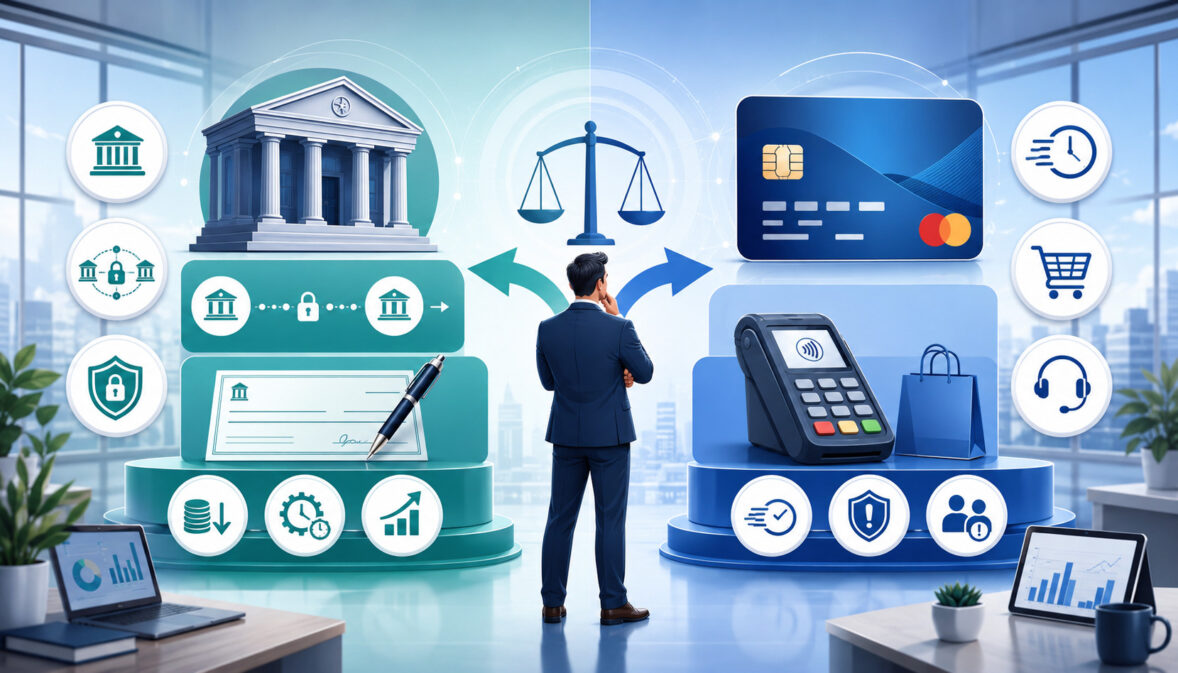
For many businesses, the question is not whether ACH payments vs credit card payments has one universal winner. The better question is: which payment method fits each transaction, customer type, billing model, and risk profile?
ACH payments are bank transfer payments that move money directly between bank accounts through the ACH Network. Credit card payments move funds through card networks, issuing banks, acquiring banks, payment processors, and merchant accounts.
Both are forms of electronic payments, but they behave very differently in cost, speed, convenience, reversibility, and compliance requirements.
A subscription business collecting predictable monthly dues may benefit from recurring ACH payments. An ecommerce seller may need credit card payments because shoppers expect fast checkout and immediate authorization.
A professional firm collecting large invoice payments may offer ACH to reduce percentage-based fees while still accepting card payments when clients prefer them.
This guide compares ACH vs credit card payments in practical terms so business owners, merchants, startups, ecommerce sellers, service providers, subscription businesses, and finance teams can make informed payment processing decisions.
What Are ACH Payments?
ACH payments are electronic bank account transfers processed through the Automated Clearing House network. Instead of using a credit card number, debit card number, or paper check, the payer authorizes money to move between bank accounts.
ACH transactions are commonly used for payroll direct deposit, vendor payments, recurring billing, memberships, tuition, rent, insurance premiums, loan payments, and invoice payments.
The ACH Network is governed by Nacha rules, which establish the legal and operational framework for participants, including authorization, return handling, formatting, and compliance responsibilities. Nacha describes its operating rules as the foundation for ACH payments and the obligations of ACH Network participants.
For businesses, ACH payment processing can be attractive because fees are often lower than card payments, especially for large invoices or recurring transactions.
Instead of paying a percentage-based fee that grows with the transaction amount, many ACH processing fees are flat, capped, or lower percentage fees depending on the payment processor, risk profile, transaction type, and service model.
ACH payments may also improve payment reconciliation because transactions can be tied to invoices, customer accounts, payment schedules, and accounting records. However, ACH is not instant by default.
ACH transactions are processed in batches, and settlement time depends on the payment processor, bank cutoffs, return windows, and whether standard or same-day ACH is used.
ACH payments work best when the customer relationship is known, the business has proper authorization, and speed at the checkout moment is less important than cost efficiency and predictable collection.
ACH debit transactions
ACH debit transactions happen when a business pulls funds from a customer’s bank account after receiving authorization. This is common for subscriptions, memberships, loan payments, utility-style billing, professional retainers, and invoice auto-pay.
For example, a software company may allow customers to authorize recurring ACH payments for monthly subscription payments. Each billing cycle, the business initiates a debit from the customer’s bank account.
The customer does not need to manually enter card details each month, and the business may avoid card expiration issues that often affect recurring credit card payments.
Authorization matters. A business should clearly document who authorized the debit, the payment amount or method for determining the amount, the timing, and how the customer can revoke authorization. Poor authorization practices can lead to ACH returns, disputes, compliance problems, and customer trust issues.
ACH debit transactions can fail for reasons such as insufficient funds, closed accounts, incorrect account numbers, revoked authorization, or account restrictions. Because ACH does not provide the same real-time approval experience as card authorization, businesses should have a process for handling failed payments quickly.
ACH credit transactions
ACH credit transactions happen when the payer pushes funds from their bank account to another account. Direct deposit payroll is a common ACH credit example. Businesses may also use ACH credits to pay vendors, issue refunds, send commissions, or move money between business accounts.
In customer-facing payment acceptance, ACH debit is often more common because the business controls the payment initiation after receiving permission. However, ACH credit can be useful for B2B payments, supplier payments, contractor payouts, and controlled disbursements.
ACH credit transactions can reduce some authorization concerns because the payer initiates the movement of funds. Still, businesses must manage bank details securely and confirm that payment data is accurate.
ACH credit may also be helpful when a customer prefers to send payment directly from their bank rather than giving a business debit authorization. This can be useful for certain professional services, large invoices, or business payments where the payer’s accounts payable team controls payment release.
What Are Credit Card Payments?
Credit card payments are card-based transactions where a customer uses a credit card to pay for goods or services. The card issuer extends credit to the cardholder, and the merchant receives payment through the card acceptance system after authorization, clearing, and settlement.
Credit card transactions typically involve several parties: the customer, the merchant, the payment gateway or terminal, the payment processor, the acquiring bank, the card network, and the issuing bank.
When a customer pays, the transaction is authorized quickly. That immediate approval or decline is one reason card payments are so popular for online payments, retail checkout, mobile payments, and service deposits.
Credit card payment benefits include customer convenience, broad familiarity, fast authorization, rewards incentives, and strong checkout compatibility. Customers often prefer credit cards because they can complete purchases quickly, use available credit, track expenses, and rely on cardholder dispute protections.
For merchants, credit card payments can increase conversion rates and support card-not-present transactions, ecommerce checkout, digital invoices, virtual terminals, recurring billing, and mobile payment acceptance. Card payments also integrate well with shopping carts, payment gateways, subscription platforms, and accounting systems.
The trade-off is cost and dispute exposure. Credit card processing fees often include interchange fees, assessment fees, processor markup, authorization fees, gateway fees, monthly fees, PCI compliance costs, and chargeback-related costs. Card payments may settle faster than standard ACH, but they usually cost more on a percentage basis.
Credit card payments are not automatically better or worse than ACH payments. They are often better when speed, convenience, immediate authorization, and customer preference matter most.
Credit card authorization
Credit card authorization is the first major step in credit card processing. When a customer enters card details online, taps a card at a terminal, or provides card information over the phone, the payment system sends a request to confirm whether the card can be used for the transaction.
The issuing bank checks factors such as available credit, account status, security data, fraud signals, and cardholder restrictions. The merchant receives an approval or decline response within seconds.
Authorization is not the same as final payment. It means the transaction has been approved for processing, not that the funds have fully settled into the merchant’s bank account. This distinction matters for businesses that ship goods later, capture payments after service delivery, or place holds for deposits.
Authorization helps reduce some payment uncertainty. Unlike ACH, where a payment can be returned later for insufficient funds or other reasons, credit card authorization gives the merchant an immediate response. However, authorization does not eliminate chargeback risk, fraud risk, refund risk, or compliance obligations.
Credit card settlement
Credit card settlement is the process of finalizing authorized card transactions and moving funds toward the merchant. After authorization, transactions are usually captured and included in a batch. The processor, acquiring bank, card network, and issuing bank then complete clearing and settlement.
Many merchants receive card deposits relatively quickly, often faster than standard ACH deposits, although exact timing depends on batch cutoff, processor policies, risk holds, weekends, bank processing schedules, and account history.
Settlement timing is important for cash flow planning. A restaurant, retail store, ecommerce brand, or field service company may rely on quick card deposits to manage inventory, payroll, and operating expenses. Faster settlement can be a meaningful advantage when compared with payment methods that take longer to confirm.
However, settlement does not make the transaction final in every sense. Customers may still dispute transactions, request refunds, or trigger chargebacks. A business should not treat card settlement as protection against poor documentation, weak refund policies, or fraud.
ACH Payments vs Credit Card Payments: Key Differences
The key differences between ACH payments and credit card payments come down to payment rails, cost structure, speed, customer experience, risk, reversibility, and use case. ACH payments move money through bank account transfer systems. Credit card payments move through card networks and credit-based accounts.
ACH payments generally cost less, especially for high-value transactions. Credit card payments usually cost more because the card ecosystem includes interchange fees, assessment fees, and processor markup. In exchange, cards provide immediate authorization, customer familiarity, and faster checkout.
ACH payments may take longer to settle and can be returned for reasons such as insufficient funds or invalid account details. Credit card payments authorize quickly but may be disputed through chargebacks. ACH returns and credit card chargebacks are not the same process, and businesses need different procedures for each.
Customer convenience also varies by context. A shopper buying a product online may prefer card payments because entering card details is familiar and fast. A client paying a large invoice may prefer bank transfer payments because they are used to paying vendors from a business account.
A subscription customer may prefer ACH if it avoids card expiration problems. Another subscription customer may prefer a card because of rewards, credit float, or easier dispute rights.
Here is a practical ACH payments vs credit card payments comparison:
| Feature | ACH Payments | Credit Card Payments | What Businesses Should Consider |
| Payment rail | Bank account transfer | Card network transaction | ACH uses bank accounts; cards use credit lines and card credentials |
| Common use cases | Recurring billing, invoice payments, B2B payments, memberships, large payments | Ecommerce, retail, deposits, urgent payments, subscriptions, card-not-present transactions | Match the method to customer expectations and transaction type |
| Authorization | Requires customer bank debit authorization or payer-initiated transfer | Real-time approval or decline | Cards give faster checkout confirmation |
| Typical cost profile | Often lower, sometimes flat or capped | Often percentage-based plus transaction fees | ACH can reduce costs on larger transactions |
| Settlement time | Often slower unless same-day options apply | Often faster after batch settlement | Consider cash flow and funding needs |
| Failed payment risk | Returns for insufficient funds, invalid account, revoked authorization | Declines at authorization, later chargebacks possible | Each method needs separate risk controls |
| Dispute process | ACH returns and unauthorized debit claims | Chargebacks through card networks and issuers | Documentation matters for both |
| Compliance focus | Nacha rules, authorization, secure bank data handling | PCI compliance, card network rules, chargeback rules | Both require secure workflows |
| Customer preference | Strong for invoices, recurring bank payments, larger balances | Strong for checkout, rewards, convenience, one-time purchases | Offering both can improve payment acceptance |
How ACH Payment Processing Works

ACH payment processing begins with authorization. For ACH debit transactions, the customer gives permission for the business to debit their bank account. For ACH credit transactions, the payer initiates a bank account transfer. In either case, payment information is routed through financial institutions and ACH operators in batches.
A typical ACH debit workflow looks like this:
- The customer provides bank account details and authorization.
- The business submits the payment through a payment processor, bank, platform, or payment gateway.
- The transaction is sent to the originating financial institution.
- The ACH operator routes the transaction to the receiving financial institution.
- The receiving institution posts the transaction or returns it if there is a problem.
- The business receives settlement according to the processor’s timeline.
ACH transactions are not processed the same way as instant card authorizations. Standard ACH settlement may take longer because entries are batched and because returns can occur after submission.
Same-day ACH can speed up eligible payments, but it still depends on cutoff times, rules, processor support, and financial institution participation. The Federal Reserve’s FedACH SameDay Service supports same-day processing and settlement for eligible ACH payments, with certain transaction types and high-value entries excluded.
Businesses using ACH payment processing should pay close attention to authorization language, account validation, return monitoring, notification procedures, and payment reconciliation. These steps reduce ACH payment risks and improve the customer experience.
ACH is also useful for recurring billing because bank accounts usually change less often than credit cards. Cards expire, get replaced, or are reissued after fraud. Bank accounts may remain stable for years, which can reduce involuntary churn for subscription payments.
For invoice-based businesses, ACH payment links can make collections smoother. A customer can pay by bank account transfer instead of mailing a check or calling in card details. This creates a digital payment trail and can reduce manual accounts receivable work.
For businesses exploring setup options, an educational overview of ACH and eCheck services can help clarify how bank-based payment acceptance fits into broader payment processing options.
How Credit Card Payment Processing Works

Credit card processing starts when a customer presents card details through a terminal, payment gateway, hosted checkout page, invoice link, virtual terminal, mobile reader, or stored payment profile. The system sends the transaction through the processor and card network to the issuing bank for authorization.
If approved, the transaction can be captured and later settled. The merchant receives funds after processing, minus applicable credit card processing fees. The customer repays the issuing bank according to their credit card account terms.
The card payment process generally includes:
- Payment data entry or card presentment
- Authorization request
- Approval or decline response
- Capture
- Batch submission
- Clearing
- Settlement
- Funding to the merchant account
- Reporting and reconciliation
Credit card payments are often preferred for ecommerce because the approval happens quickly. A customer can complete an order, receive confirmation, and move on. The merchant can decide whether to fulfill immediately, capture later, or use fraud screening tools before shipping.
Credit card processing also supports recurring credit card payments. A business can store tokenized card credentials, bill customers on a schedule, and use account updater tools where available. This is common for software subscriptions, memberships, digital services, retainers, insurance billing, and installment payments.
The downside is that stored card billing requires strong security controls. Businesses that accept card payments must understand PCI compliance responsibilities. The PCI Security Standards Council provides payment data security standards and resources designed to help protect cardholder data.
Credit card transactions may also be affected by interchange qualification, card type, entry method, industry type, risk level, card-not-present status, and data quality.
For B2B sellers, certain commercial card transactions may cost less when enhanced data is submitted properly. For ecommerce sellers, fraud tools such as address verification, CVV checks, device signals, velocity controls, and payer authentication can help reduce risk.
For additional context on fraud controls, this guide to using CVV and AVS checks to reduce fraud explains why security data matters in card-not-present payment acceptance.
Cost Comparison: ACH Processing Fees vs Credit Card Processing Fees

Cost is one of the biggest reasons businesses compare ACH payments vs credit card payments. In many situations, ACH processing fees are lower than credit card processing fees. The difference becomes more noticeable as transaction size increases.
Credit card processing fees usually include several layers. Interchange is often the largest component and is tied to the card type, transaction environment, risk factors, and network rules. Assessment fees are charged by card networks.
Processor markup is charged by the payment processor or merchant services provider. There may also be payment gateway fees, monthly fees, PCI-related fees, batch fees, chargeback fees, and other service charges.
The Federal Reserve publishes information related to debit card interchange and merchant fraud losses under Regulation II, highlighting that card acceptance costs are a regulated and closely watched part of the payments ecosystem.
Credit card fees are not identical to debit card fees, but the broader point is important: card payments carry a structured fee system that businesses should understand rather than treating the rate as one simple number.
ACH fees are usually simpler, but not always. Some processors charge a flat per-transaction fee. Others charge a percentage with a cap, a monthly platform fee, a return fee, an account validation fee, or an expedited settlement fee. Same-day ACH may carry a higher cost than standard ACH.
For a small ecommerce transaction, the fee difference may be less important than conversion. For a large invoice, the difference can be significant. A card fee on a large invoice may materially reduce margin, while an ACH fee may remain relatively modest.
Transaction fees
Transaction fees are the direct charges tied to each payment. With ACH payments, transaction fees may be flat or lower percentage-based charges. With credit card payments, fees often include a percentage of the sale plus a fixed per-transaction amount.
For example, a business collecting a small one-time payment may find that the difference between ACH and card cost is not worth adding checkout friction. A customer may abandon a purchase if asked to find bank routing and account details. In that case, credit card payment benefits may outweigh higher fees.
For a large invoice payment, the calculation changes. A percentage-based card fee can become expensive quickly. A bank account transfer may produce meaningful savings, especially for B2B payments, professional services, tuition, rent-like billing, wholesale orders, retainers, or high-ticket services.
Transaction fees should be measured by payment type, average ticket size, payment channel, and customer segment. The cheapest method on paper may not be the best method if it lowers conversion or increases manual work.
Monthly fees
Monthly fees may apply to both ACH payment processing and credit card processing. These can include account fees, statement fees, gateway fees, platform fees, compliance fees, software fees, or support fees.
A business should ask whether monthly fees are bundled or itemized. A low transaction rate may not be the lowest total cost if the platform adds fixed fees, minimums, or separate charges for features the business actually needs.
For example, a subscription business may need customer vault storage, recurring billing tools, failed payment notices, automatic retries, reporting exports, and integration with accounting software. These tools may carry monthly fees, but they can save labor and reduce missed revenue.
Monthly fees should be evaluated in the context of total value. A higher platform cost may be reasonable if it improves reconciliation, reduces payment failures, supports both ACH and card payments, and gives finance teams better reporting.
Payment gateway fees
Payment gateway fees apply when a business uses software to securely transmit payment data, support online checkout, send invoice payment links, run virtual terminal transactions, or manage recurring billing. Gateway fees can apply to card payments, ACH payments, or both.
A payment gateway may charge a monthly fee, per-transaction gateway fee, authorization fee, tokenization fee, account updater fee, fraud tool fee, or integration fee. These costs should be included in any ACH transfer vs credit card payment comparison.
Gateway features matter as much as price. A low-cost gateway that lacks ACH support, recurring billing flexibility, tokenized storage, invoice links, or reporting may create more back-office work. A more capable gateway may lower total operating cost even if the monthly fee is higher.
Businesses comparing tools may find it helpful to review how a merchant account and payment gateway differ, especially when deciding whether to use a dedicated merchant account, payment service provider, or integrated platform.
Speed and Settlement Times
Speed is one of the clearest differences between ACH payments and credit card payments. Credit card payments usually provide immediate authorization, while ACH payments generally do not. However, authorization speed and funding speed are not the same.
With credit card payments, the merchant often knows within seconds whether the transaction is approved or declined. This is valuable for ecommerce, retail, mobile service work, deposits, urgent orders, and any situation where the business needs quick confirmation before delivering goods or services.
Card funding typically happens after batch settlement. Many businesses receive card deposits within a short funding window, but exact timing depends on processor policies, batch cutoff, risk review, bank holidays, reserve requirements, and transaction type.
ACH settlement time is usually slower. Standard ACH may take one or more business days, and returns may arrive after the initial submission. Same-day ACH can accelerate eligible transactions, but it still operates within defined processing windows and rules.
Nacha notes that ACH payments settle when the Federal Reserve’s National Settlement Service is open, so settlement does not currently occur on weekends or federal holidays.
For cash flow planning, this distinction is important. A business that relies on immediate confirmation may prefer credit card payments. A business that collects predictable invoices may accept ACH settlement timing because the lower cost is worth it.
Settlement timing also affects fulfillment policy. If an ACH payment is used for a high-value order, a business may wait until the payment is fully settled or until return risk is reduced before shipping. For low-risk recurring customers, the business may be comfortable delivering service before final settlement.
Cash flow planning
Cash flow planning requires looking beyond advertised settlement times. A processor may describe a typical funding schedule, but actual cash availability can vary. Weekends, holidays, cutoff times, risk reviews, returns, chargebacks, and reserves can all affect when money is truly usable.
ACH payments can be excellent for predictable cash flow when customers are billed on a schedule. For recurring ACH payments, a business can forecast expected collections and plan around standard settlement timing. This works well for memberships, retainers, tuition, managed services, and subscription payments.
Credit card payments can support quicker revenue recognition at checkout, especially when immediate authorization is needed. However, chargebacks, refunds, and processing fees can complicate forecasting.
Businesses should map each payment method to its operational timeline. When is the payment initiated? When is it authorized? When is it submitted? When does it settle? When can it be returned or disputed? When does accounting mark the invoice paid?
Security, Fraud, and Compliance Considerations
Both ACH payments and credit card payments require serious security controls. The risks are different, but neither method should be treated casually.
ACH payment security focuses on protecting bank account information, obtaining valid authorization, verifying account details, controlling access to payment data, monitoring suspicious activity, and complying with Nacha rules. Businesses should also have procedures for handling revoked authorization, unauthorized return claims, and failed payments.
Credit card payment security focuses heavily on protecting cardholder data and reducing fraud in card-present and card-not-present environments. PCI compliance is central because businesses that accept, process, transmit, or store cardholder data may have responsibilities under PCI DSS.
Using hosted payment pages, tokenization, secure payment gateways, and validated service providers can reduce risk and limit the amount of sensitive data the business handles directly.
Fraud patterns differ by payment method. ACH fraud may involve unauthorized debits, stolen bank account details, account takeover, fake vendor changes, or manipulated payment instructions. Card fraud may involve stolen card numbers, synthetic identities, friendly fraud, refund abuse, testing attacks, or card-not-present fraud.
For ecommerce sellers, card-not-present transactions deserve special attention because the card is not physically presented. Fraud prevention tools may include CVV checks, address verification, device fingerprinting, velocity limits, payer authentication, order review queues, and shipping controls.
For ACH, fraud prevention may include bank account validation, micro-deposit verification, prenote or account verification services, customer identity checks, transaction limits, dual approval for changes, and monitoring unusual payment behavior.
Payment security
Payment security should be built into the payment flow rather than added after problems occur. Businesses should limit who can access payment data, avoid storing sensitive information unnecessarily, and use systems that support encryption, tokenization, role-based permissions, audit trails, and secure reporting.
For ACH payments, staff should not collect bank account details through unsecured email, shared documents, or informal messages. A secure form, payment portal, or approved authorization process is safer and easier to audit.
For credit card payments, businesses should avoid writing card numbers down, storing full card data in spreadsheets, or entering card information into unapproved systems. A secure payment gateway or hosted checkout page can reduce exposure.
Security also includes training. Employees should understand phishing, business email compromise, refund fraud, social engineering, and payment instruction changes. Many payment losses start with process failure, not technology failure.
Fraud risk
Fraud risk depends on the transaction type, customer relationship, sales channel, and controls. A recurring ACH payment from a known customer has a different risk profile than a first-time online card order shipping to a new address. A large B2B invoice paid by bank transfer has different risks than a small retail card transaction.
Credit card payment risks include stolen card use, chargebacks, account testing, and friendly fraud. ACH payment risks include unauthorized debit claims, insufficient funds, invalid account details, and bank account takeover.
Businesses should not rely on one control. Strong fraud prevention uses layers. For cards, combine gateway tools, customer verification, order review, shipping rules, and dispute documentation. For ACH, combine authorization records, bank account validation, payment limits, return monitoring, and customer communication.
Chargebacks, ACH Returns, and Payment Disputes
Payment disputes are a major part of the ACH payments vs credit card payments decision. Credit card disputes usually appear as chargebacks. ACH disputes appear through ACH returns, including unauthorized debit claims and administrative returns.
A chargeback occurs when a cardholder disputes a credit card transaction through their issuer. Reasons may include fraud, non-receipt of goods, duplicate billing, canceled recurring billing, product not as described, processing error, or customer confusion. The merchant may have an opportunity to respond with evidence through chargeback representment.
Credit card disputes are influenced by card network rules, issuer decisions, documentation quality, refund policy clarity, delivery proof, customer communication, and transaction data. Consumer credit dispute rights are also shaped by Regulation Z, which covers billing error resolution and other credit protections.
ACH returns are different. An ACH transaction can be returned for insufficient funds, closed account, invalid account number, account not found, unauthorized debit, revoked authorization, or other reasons.
Return timing and handling depend on the return reason and transaction type. Businesses must monitor return rates because high return rates can create compliance and processing problems.
Chargebacks
Chargebacks are one of the most important credit card payment risks. They can cost more than the original transaction fee because the merchant may lose revenue, pay a chargeback fee, spend staff time preparing evidence, and absorb product or service costs.
Good chargeback prevention begins before the sale. Clear product descriptions, transparent billing terms, recognizable billing descriptors, confirmation emails, delivery tracking, cancellation procedures, refund policies, and responsive support can reduce disputes.
For recurring credit card payments, chargebacks often happen when customers forget they subscribed, do not recognize the billing descriptor, believe they canceled, or cannot reach support quickly. Subscription businesses should send billing reminders where appropriate, make cancellation terms easy to find, and document customer consent.
For businesses that need a structured dispute response process, this chargeback representment playbook explains how documentation and repeatable workflows can improve dispute handling.
ACH returns
ACH returns are not the same as chargebacks, but they can still disrupt cash flow. A returned ACH payment means the transaction could not be completed or was reversed through the ACH return process.
Common return reasons include insufficient funds, invalid account information, closed account, unauthorized debit, payment stopped, or authorization revoked. Some are administrative problems. Others indicate customer intent or possible fraud.
Businesses should track return codes and respond accordingly. An insufficient funds return may call for customer outreach and a retry policy. An invalid account return may require corrected bank information. An unauthorized return should be treated seriously and should not be retried without proper authorization.
ACH returns also affect customer experience. If a payment fails silently and service is interrupted without notice, customers may become frustrated. Automated notifications, grace periods, retry rules, and self-service payment update links can help.
Failed payments
Failed payments happen with both ACH and cards, but the reasons differ. Credit card transactions may fail because of expired cards, insufficient credit, fraud blocks, issuer declines, incorrect CVV, address mismatch, or card replacement. ACH payments may fail because of insufficient funds, wrong account details, closed accounts, or revoked authorization.
The best failed payment strategy is proactive. Use reminders, account update tools, retry logic, customer notifications, and easy payment method updates. For high-value invoices, have a direct follow-up process rather than relying only on automated emails.
Best Use Cases for ACH Payments
ACH payments are often the best fit when cost efficiency, predictability, and bank account billing matter more than instant authorization. They are especially useful for recurring billing, invoice payments, B2B payments, high-ticket services, memberships, tuition, rent-like payments, professional retainers, and account-based billing.
The biggest ACH payment benefits usually appear when the transaction amount is large or repeated over time. A percentage-based card fee can become expensive on a large invoice. ACH processing fees may be much lower, making ACH attractive for businesses with thin margins, large balances, or high monthly volume.
ACH also works well when the customer relationship is established. A known client paying monthly invoices by bank account transfer presents a different risk profile than a first-time buyer making an online purchase. When trust and authorization are in place, ACH can support reliable payment collection.
For subscription businesses, recurring ACH payments can reduce involuntary churn caused by expired cards or reissued card numbers. Customers who authorize bank account billing may stay successfully billed for longer periods, provided the business manages returns and communication properly.
For service providers and professional firms, ACH can make invoice payments easier. A customer can click a secure link, authorize a bank account transfer, and pay without mailing checks or calling in card details.
Recurring billing
Recurring ACH payments are a strong option for predictable billing relationships. Examples include memberships, tuition, managed services, software subscriptions, insurance-like billing, loan repayment, retainers, maintenance contracts, and installment plans.
ACH can be cost-effective because each billing cycle does not carry the same percentage burden as many card payments. It can also reduce card expiration issues. A card may expire every few years or be replaced after fraud, but a bank account may remain unchanged for much longer.
However, recurring ACH billing requires clear authorization and customer communication. Customers should understand the amount, timing, frequency, and cancellation process. Businesses should store authorization records securely and make it easy for customers to update bank information.
A strong recurring billing process also includes failed payment notifications, retry logic, account status rules, and clear customer support paths.
Subscription payments
Subscription payments are a good example of where ACH payments and credit card payments can work together. Some customers want the convenience and rewards of card payments. Others prefer direct debit payments from a bank account.
A subscription business may present both options but encourage ACH for annual plans, larger accounts, business customers, or long-term contracts. Credit cards can remain available for smaller plans, quick signup, trials, or customers who prefer card billing.
The best choice depends on customer expectations. A consumer-style digital subscription may convert better with cards. A B2B software contract may work well with ACH invoice auto-pay.
Subscription teams should measure approval rates, involuntary churn, payment recovery, fees, and customer support tickets by payment method. The right answer may vary by plan size and customer segment.
Invoice payments
ACH is often a good fit for invoice payments because many invoice amounts are larger than retail purchases. Businesses, professional firms, contractors, agencies, consultants, wholesalers, and service providers can reduce payment costs by offering bank account transfer options.
Invoice ACH payments can also reduce check handling. Paper checks create delays, mail risk, deposit work, and manual reconciliation. ACH creates a digital record and may integrate with accounting systems.
The invoice should make payment choices clear. If ACH is preferred for larger balances, the payment page can present bank payment prominently while still offering card payments for customers who need speed or prefer card rewards.
For B2B sellers specifically, this resource on reducing credit card fees in B2B payments provides useful context on why payment mix matters for larger invoices.
B2B payment acceptance
B2B payment acceptance is one of ACH’s strongest use cases. Business buyers often pay invoices through accounts payable workflows, not impulse checkout. They may prefer bank transfers, scheduled payments, or payment portals that capture invoice numbers and remittance details.
ACH can help sellers reduce payment acceptance costs while improving digital collections. It can also support recurring vendor relationships where the same customer pays every month.
However, B2B customers are not all the same. Some prefer cards for float, rewards, procurement controls, or virtual card programs. Others prefer ACH for cost and accounting simplicity. A flexible payment setup is usually better than forcing one method across all customers.
Best Use Cases for Credit Card Payments
Credit card payments are often the best fit when convenience, speed, immediate authorization, and customer expectations are the priority. They are especially important for ecommerce, retail, mobile services, deposits, online booking, reservations, emergency services, digital products, and customer-facing checkout.
Many customers expect to pay by card. Removing card payments can reduce conversion, especially for online sales. Even if ACH is cheaper, it may create too much friction when the customer is ready to buy.
Credit card payment benefits include fast approval, familiar checkout, customer rewards, easier one-time payments, and compatibility with payment gateways, shopping carts, mobile wallets, and virtual terminals. Cards also work well when the merchant needs immediate confirmation before fulfilling an order.
For ecommerce sellers, credit card payments are often essential. Card-not-present transactions may carry higher fraud risk and fees, but the checkout experience is familiar. Customers can pay quickly without searching for routing and account numbers.
For service providers, credit cards are useful for deposits, retainers, urgent invoices, and payment at the time of service. A contractor, medical office, repair company, or consultant may accept cards to reduce friction even if ACH is preferred for larger balances.
Customer convenience
Customer convenience is one of the strongest reasons to accept credit card payments. Customers know how cards work. They can enter details quickly, use saved cards in browsers or wallets, and receive immediate confirmation.
Convenience directly affects conversion. If checkout is too difficult, customers may abandon the purchase. A low-cost payment method is not helpful if it prevents customers from completing payment.
Credit cards also support customer preferences such as rewards, credit float, purchase tracking, and cardholder dispute protections. Some customers may choose a card even when ACH is available because the card fits their personal or business finance workflow.
Businesses should measure payment method preference rather than assume. Customer behavior may differ by sales channel, transaction amount, buyer type, and urgency.
Online payments
Online payments rely heavily on speed and trust. Credit card payments work well because they integrate with ecommerce platforms, payment gateways, fraud tools, digital wallets, and automated receipts.
A shopper buying a product online may not want to enter bank account information. Card checkout is familiar and fast. This is especially true for first-time customers who do not yet have a relationship with the merchant.
For online services, cards also support trials, deposits, upgrades, usage-based billing, and self-service account management. Stored card profiles can make repeat purchases easier.
However, online card payments require strong fraud controls. Card-not-present transactions are more exposed to stolen card use and friendly fraud. Merchants should combine secure checkout, fraud screening, clear policies, and fulfillment controls.
Urgent or one-time payments
Credit cards are often better for urgent or one-time payments because the merchant receives an immediate authorization response. This matters when a customer needs same-day service, immediate access, emergency repair, quick shipping, or a time-sensitive reservation.
ACH can work for one-time payments, but it may be less convenient if the customer has to enter bank details and wait for processing. Same-day ACH may help in some cases, but it still does not provide the same checkout experience as card authorization.
For one-time payments, the higher card cost may be acceptable because the payment is easier to complete. The business should focus on reducing fraud and ensuring the transaction is properly documented.
How to Choose the Right Payment Method for Your Business
Choosing between ACH payments and credit card payments requires more than comparing fees. The right payment method depends on transaction size, customer preference, speed, risk, billing frequency, business model, payment channel, and operational workflow.
Start with your transaction profile. What is your average ticket size? How many transactions are recurring? How many are invoice-based? How many are first-time purchases? How many are urgent? How often do customers dispute payments? How often do payments fail?
Next, evaluate customer behavior. Do customers expect card checkout? Are they businesses paying from accounts payable departments? Are they consumers paying monthly subscriptions? Do they value rewards, convenience, or lower-cost bank payments?
Then consider cash flow. If you need immediate authorization and fast fulfillment, credit cards may be important. If you can wait for ACH settlement and want to lower costs, ACH may be better for selected transactions.
Finally, review risk and compliance. Card payments require PCI compliance and chargeback management. ACH payments require proper authorization, secure bank data handling, return monitoring, and compliance with Nacha rules.
Many businesses should accept both ACH and credit card payments. Offering both creates flexibility. You can use card payments for checkout speed and ACH payments for lower-cost recurring or invoice payments.
Payment method comparison questions
Before choosing a payment setup, ask practical questions:
- What is our average transaction amount?
- Which customers prefer bank transfer payments?
- Which customers expect card payments?
- How quickly do we need authorization?
- How quickly do we need funds available?
- What are our ACH processing fees and credit card processing fees?
- How often do we deal with chargebacks or ACH returns?
- Do we need recurring billing?
- Do we need invoice payment links?
- Does our payment gateway support both ACH and cards?
- Can our system sync payments to accounting software?
- What fraud prevention tools are included?
- How are disputes, returns, refunds, and failed payments reported?
- Are pricing terms transparent and easy to reconcile?
These questions help avoid choosing a payment processor based only on a headline rate. The right payment processor should support your actual payment acceptance workflow.
When offering both makes sense
Offering both ACH and credit card payments often makes sense when a business serves different customer types or collects different transaction sizes.
For example, an ecommerce seller may rely on credit cards for checkout but offer ACH for wholesale buyers. A subscription company may accept cards for small monthly plans and ACH for enterprise accounts. A professional firm may request ACH for large invoice payments while keeping cards available for client convenience.
Offering both can improve customer experience while controlling costs. Customers get choice. The business can guide lower-cost behavior where appropriate.
The key is presentation. If every payment option appears equal in every context, customers may choose the most expensive method for the business. A better approach is to design payment flows around use case. Show ACH prominently for invoices and recurring billing. Show cards prominently for fast checkout.
Choosing a payment processor or gateway
When comparing payment processing options, look for support beyond basic acceptance. A good setup should help with authorization records, fraud prevention, PCI compliance, ACH returns, chargebacks, reporting, payment reconciliation, customer notifications, and integration with your existing systems.
Ask whether the payment gateway supports both ACH and card payments. Confirm whether recurring billing works for both methods. Review how failed payments are handled. Check whether the system stores payment credentials securely using tokenization or similar controls.
Also review reporting. Finance teams need clear transaction status, settlement reports, return details, chargeback alerts, fees, deposits, and invoice matching. Weak reporting can create accounting problems even if the processing rate looks attractive.
If you are still deciding how payment accounts, gateways, and processors fit together, this educational guide on different types of merchant accounts can help clarify payment setup options.
FAQs
What is the difference between ACH payments and credit card payments?
ACH payments move money directly between bank accounts through bank transfer payment rails. Credit card payments move through card networks and involve a cardholder’s credit account, issuing bank, acquiring bank, payment processor, and merchant account.
The biggest practical differences are cost, speed, authorization, and dispute handling. ACH payments are often lower cost but slower. Credit card payments usually authorize quickly but carry higher fees and chargeback exposure.
Are ACH payments cheaper than credit card payments?
ACH payments are often cheaper, especially for large invoices, recurring billing, and B2B payments. ACH processing fees are commonly lower than credit card processing fees because they do not use the same interchange-based card network structure.
However, ACH is not always the cheapest in every situation. Businesses should include return fees, monthly platform fees, account validation fees, gateway fees, staff time, and failed payment handling when comparing total cost.
Are credit card payments faster than ACH payments?
Credit card payments are usually faster at the authorization stage because approval or decline happens within seconds. Funding time depends on batch settlement, processor policies, and risk factors.
ACH payments usually take longer because they are batch-based bank account transfers. Same-day ACH may speed up eligible payments, but it still depends on rules, cutoff times, and processing support.
Which payment method is better for recurring billing?
Both can work well for recurring billing. Recurring ACH payments are often better for larger recurring invoices, memberships, retainers, tuition, and business subscriptions because bank accounts may remain stable longer than cards and fees may be lower.
Recurring credit card payments are often better when customers expect quick signup, rewards, or consumer-style subscription convenience. Many subscription businesses benefit from offering both.
Are ACH payments secure?
ACH payments can be secure when handled correctly. Businesses should use secure authorization forms or payment portals, protect bank account data, limit internal access, validate account information where appropriate, and follow Nacha rules.
ACH security depends heavily on process quality. Collecting bank details through unsecured messages or storing authorization records carelessly increases risk.
Can ACH payments be reversed?
ACH payments can be returned or reversed in certain situations, such as insufficient funds, invalid account information, stopped payment, revoked authorization, or unauthorized debit claims. ACH returns are different from credit card chargebacks, but they can still affect cash flow.
Businesses should monitor ACH return codes, keep authorization records, and avoid retrying transactions improperly after unauthorized returns.
Do credit card payments have higher fees?
Credit card payments usually have higher fees than ACH payments. Credit card processing fees often include interchange fees, assessment fees, processor markup, authorization fees, gateway fees, and chargeback-related costs.
The higher cost may still be worthwhile when card payments increase conversion, support immediate authorization, or meet customer expectations.
Should businesses accept both ACH and credit card payments?
Many businesses should accept both. ACH payments can reduce costs for recurring billing, invoice payments, and larger transactions. Credit card payments can improve convenience, support fast checkout, and provide immediate authorization.
A balanced payment strategy lets customers choose while allowing the business to guide payment behavior based on transaction size, speed, risk, and cost.
Conclusion
ACH payments vs credit card payments is not a one-size-fits-all decision. ACH payments are often better for lower-cost bank account transfers, recurring ACH payments, invoice payments, B2B payments, and larger transactions where percentage-based card fees can reduce margins.
Credit card payments are often better for fast checkout, immediate authorization, ecommerce, urgent payments, deposits, and customer convenience.
The best option depends on your business model, transaction size, customer expectations, settlement time needs, risk tolerance, payment security requirements, and back-office workflow.
ACH payment benefits include lower processing costs, predictable recurring billing, reduced reliance on paper checks, and strong fit for invoice-based payments. ACH payment risks include returns, insufficient funds, authorization issues, slower settlement, and bank data security responsibilities.
Credit card payment benefits include speed, convenience, customer familiarity, fast authorization, and strong compatibility with online payments. Credit card payment risks include higher fees, chargebacks, fraud exposure, PCI compliance obligations, and more complex pricing.
For many businesses, the strongest strategy is to offer both ACH and credit card payments. Use ACH where cost efficiency and predictability matter. Use credit cards where convenience and immediate approval matter.
Then support both with secure systems, clear policies, strong reconciliation, transparent customer communication, and a payment processor or gateway that fits your workflow.
A smart payment method comparison should not ask, “Which payment type is always better?” It should ask, “Which payment type is better for this customer, this transaction, and this business goal?”